Central Bank Independence and Sovereign Borrowing
Abstract
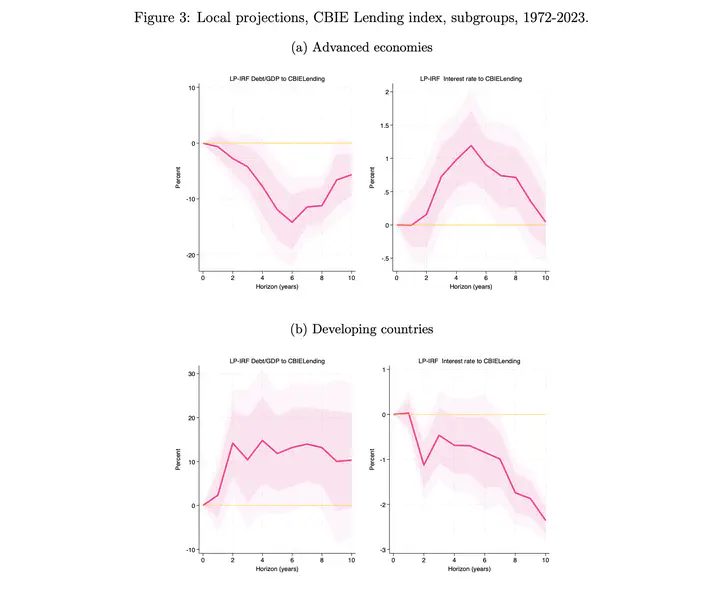
We study how reforms that tighten statutory limits on central-bank lending to government affect sovereign borrowing in 155 countries over 1972-2023. Using instrumental-variable local projections, we estimate their effects on public debt and real effective implicit interest rates. We find that in developing economies tighter constraints raise debt-to-GDP while reducing real borrowing costs. A median-sized reform temporarily increases debt-to-GDP by about 12 percentage points at its two-year peak, and lowers the real effective implicit interest rate by roughly 6 percentage points after five years, an effect that persists over the ten-year horizon. Foreign-held external public debt also rises persistently. Advanced economies show a smaller debt response of the opposite sign and no decline in borrowing costs. The real-rate decline persists under alternative debt denominators and relative to the United States. State-dependent estimates show that lower borrowing costs are strongest in high-inflation developing economies, consistent with statutory lending constraints improving sovereign borrowing conditions where credibility gains are greatest.